-
And now, your Opening Day MLB picks
Hey, it’s Opening Day. Look at that. Life isn’t as terrible as we all thought.
In devouring baseball articles and podcasts leading up to the opener, it’s clear that everyone loves the same teams. The Astros are too good to regress. The Yankees are too strong at the plate to get out. The Dodgers have too much money to fail. The Indians, Cubs, and Red Sox are all smart and loaded. The Nationals have Bryce Harper in a walk year. Even the Angels, who disappoint everyone annually, have the excitement of Shohei Ohtani.
Even normally conservative prediction algorithms are drooling over the top-heavy nature of the sport. According to Fangraphs’s playoff prediction odds chart, there are seven teams (all those mentioned above, minus the Angels) that are at least 84% likely to make the playoffs. Eighty-four percent!
So I’m not going to bore you with picks for playoff spots (fine…besides the obvious seven, give me the Rockies, Mariners, and Brewers for wild card spots). Let’s make some more interesting predictions, instead. (And, OK, maybe I’ll make a World Series pick too.)
The Mariners trade for Manny Machado.
This pick is based in very little fact, so bear with me. It’s really hard to determine what Machado’s value will be, and since the Orioles decided not to maximize it by trading him in the offseason (or even earlier) or give him a fat extension, I don’t think we can trust them to play it right heading into the deadline.
From a narrative perspective, it makes all the sense in the world to me that the Mariners go all-in (as much as they can with their roster). Three of their best players have a lot of wear and tear; if you think a Felix-Cano-Cruz-led Seattle squad is remotely competitive beyond this year, you are very confident in them beating the aging curve. Let’s dream a little that it’s June, all three of those guys are healthy and effective, and James Paxton hasn’t spontaneously combusted. The Angels are doing their usual mediocre thing, the Astros are winning the division on autopilot, and most of the AL is either really good or really bad, so the wild card is really only realistic for a handful of teams. The Mariners have an opportunity to make a big play and trade…well, it’s not clear exactly what, because their farm system is awful. But they swing something, and land the biggest chip that will be available, on their way to a playoff run (which ends in getting destroyed by the Yankees, who then sign Machado in the offseason, just to rub it in).
Mookie Betts wins the AL MVP.
Everyone is predicting the Red Sox’s hardware winner to be Chris Sale, which is perfectly reasonable. But I like Mookie as an MVP candidate because I think the Red Sox will be a “surprise,” in the way a $200ish million roster can surprise anyone. The Yankees have been pumped up all offseason, but there is plenty of downside risk in that roster: The relatively weak rotation, Giancarlo Stanton’s lack of experience playing in front of more than a few dozen people who are napping, the unpredictability of bullpen performance (not to mention some concerning signs of decline by Aroldis Chapman recently), the rookie manager who must contend with World Series expectations in the biggest media market, and so on. That team is not a lock — they’re likely to be very good, but there’s plenty of room for error.
And while there’s room for error in Boston, too, I think on a very basic level many of the team’s best players will be better this year than last, starting with Mookie, who was better than people remember, but not as good as two years ago. Andrew Benintendi, Rafael Devers, David Price, Jackie Bradley, and Xander Bogaerts can all reasonably be expected to contribute more in 2018 than they did in 2017, and JD Martinez should easily eclipse the production of Hanley Ramirez and whatever other nonsense the Red Sox tried to pass off as a slugging DH last year.
So you’ve got a team that is likely to be very good but in the shadow of New York. And if New York falters at all and Boston stays with them — especially if they manage to win the East — Mookie emerges as an MVP favorite.
Toronto will attempt the Yankees-style quick rebuild.
The Yankees gave big-market teams something of a blueprint for how to rebuild and get back to contention quickly, and I think we’ll see Toronto try to replicate that. They’ve got top-level prospects in Vlad Jr. and Bo Bichette not far away, and a team that was a serious contender not so long ago.
I’m not sure what the specifics will be, and I think it could be just about anything, but I think we will see major moves from the Blue Jays, and ones that might not make a lot of sense on first blush. Maybe that both trade Josh Donaldson and acquire a major salary (what about the long-rumored Joey Votto trade?) for prospects. Maybe they trade multiple big-league pieces and extend Josh Donaldson despite performing poorly. The point is, I think they will act fast and make significant moves, rather than be satisfied with Orioles-level mediocrity.
The Cubs remind everyone that they were the Astros before the Astros were the Astros.
It’s amazing to me how quickly people seem to have forgotten the core that Theo et al put together in Chicago. I know they’ve got some aging players, and they’ve got some disappointing signings, but with the bulk of that team young and improving, I just don’t see why we’ve all moved on from them so quickly. I think the Cubs were already loaded, and replacing a declining Jake Arrieta with a potentially declining but better Yu Darvish will only help. And even though he’s been disappointing for two years, I think Jason Heyward’s bat still has life in it.
World Series pick: Cubs over Indians in 6.
-
A few assorted thoughts from tonight’s Sea Dogs loss
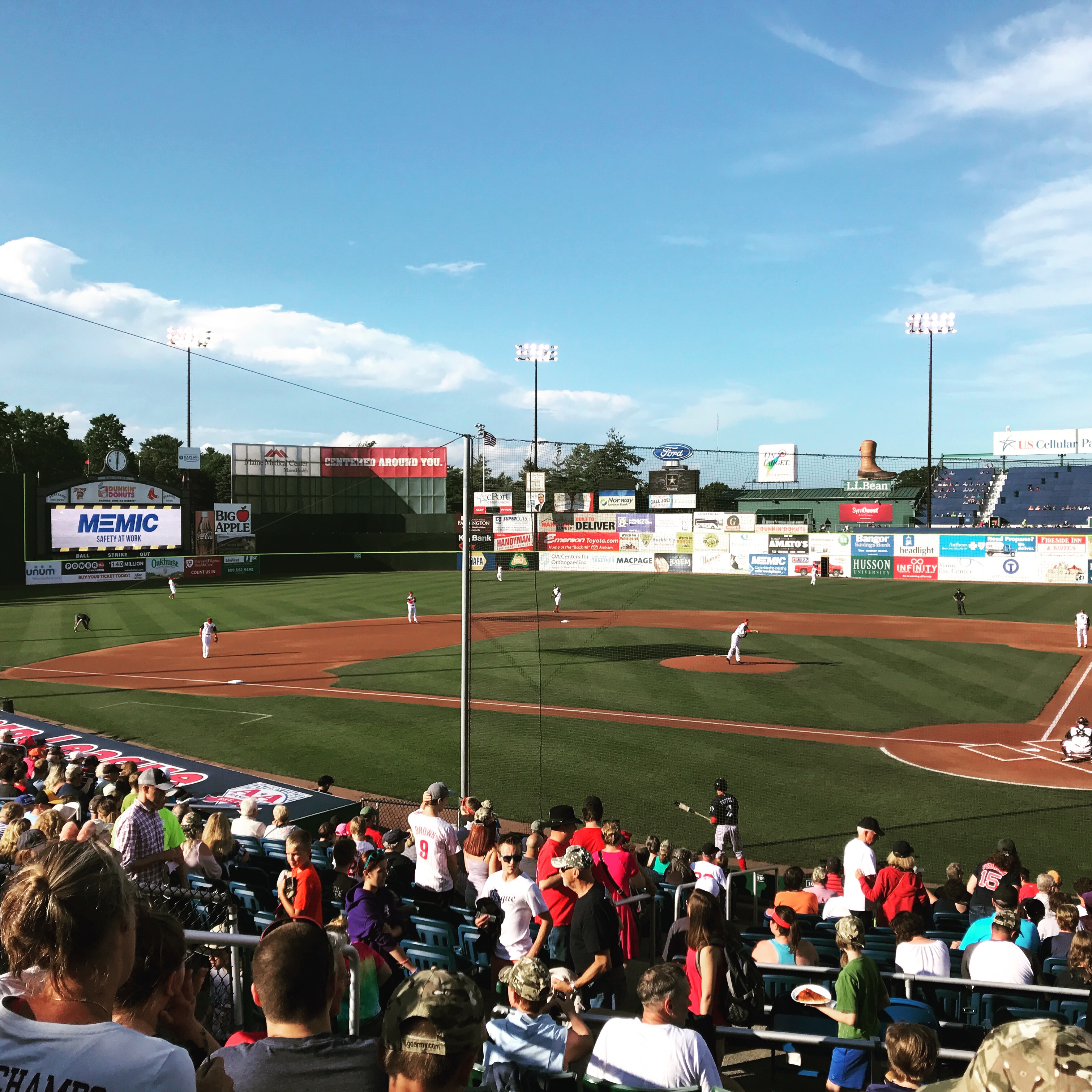
In the interest of satisfying the who-what-when-where portion of writing, I’ll tell you that I went to the Sea Dogs game at Hadlock Field in Portland tonight, and the Sea Dogs lost to Reading, the Phillies’ AA affiliate, 4-3.
But it was minor league baseball, and we all know that the outcome isn’t really that important compared to individual performances and the random inherent nonsense at the ballpark.
So here are some assorted thoughts:
- The main reason to go to a Sea Dogs game these days is Rafael Devers, one of just two of the Sox’ top 31 prospects to currently play for Portland, according to SoxProspects.com. (A pitcher is on the DL, helping to exaggerate this number.) Naturally, Devers wasn’t playing, so the main draw was no. 4 prospect 3B Michael Chavis, who went 0-for-4 with a strikeout. On the plus side, he was solid on defense.
- One of the reasons minor league baseball is such a joy to watch is it moves along incredibly quickly. They use a pitch clock and fill the inning breaks with silly games featuring kids and mascots, but more importantly the managers don’t swap in new pitchers every time the wind changes direction. Each team only used one reliever, and it made for a crisp pace — we were out of there in two hours, and it never felt boring even though it was mostly a pitchers’ duel.
- Portland’s lefty reliever Luis Ysla, most famous to me as a serviceable bullpen arm in an Out of the Park baseball simulation I did, threw either 9 or 10 straight balls upon appearing in the game. He conceded what would be the losing run and took the loss, but he stayed in the game and was, I would argue, on the whole pretty effective. 2 2/3 innings, 2 hits, 2 runs, 2 walks, 2 strikeouts, and he was throwing gas in the 9th. (I never trust the gun at the park, but he was mid-90s.) The crowd razzed him when he finally threw his first strike and recorded his first out, but he kept his composure and pulled it together.
- The Sea Dogs’s starter was Elih (pronounced Eli, the purpose of the “h” is beyond me) Villanueva, who had a 1.99 WHIP coming in, so needless to say I was expecting an offensive evening. He actually looked very sharp. He didn’t throw hard at all, cracking 90 only a couple of times that I can recall, but he struck out quite a few Fightin’ Phils on offspeed stuff. He finished the night with 7 strikeouts in 6 1/3 IP; anecdotally I believe six of the seven were on off-speed or breaking pitches, and two were caught looking.
- Two homers on the night: Chad Of the War (Chad de la Guerra to those of you who speak one language) on the second at-bat of the night, and Jeremy Barfield off the first pitch of the Reading closer in the 9th. From memory, de la Guerra’s homer was the hardest-hit ball of the night, but give me a generous room for error on that statement.
- My favorite part of the night was an error by the Sea Dogs second baseman, Deiner Lopez, who back-handed a ball he should have been able to get cleanly in front of, and bobbled it. I immediately said “they would’ve had that in the big leagues,” drawing a sizeable eyeroll from my wife; half a second later a guy in the row in front of me said “that won’t play in the majors,” and I was vindicated.
-
What should the Red Sox do about the bullpen?
I’ve read a lot of articles talking about what the Red Sox should do with their offseason, and they all seem to lead to the same conclusions: Find a way to replace David Ortiz’s bat, add a couple of relievers and maybe an extra starter, and then roll out last year’s roster otherwise untouched.
I understand the logic behind this theory, and it even seems like Red Sox management agrees. Dave Dombrowski has indicated that big moves like last year’s acquisitions of David Price and Craig Kimbrel are unlikely, and with the bulk of Boston’s team young and on the rise (or in their prime), a complete overhaul would seem unnecessary. And that’s not even factoring in the massive changes made to the front office.
Replacing Ortiz’s bat comes down to three ideas: Sign Edwin Encarnacion for big money, sign a player like Jose Bautista or Carlos Beltran for a shorter commitment, or turn DH into a revolving door of bats young and old. Adding a starter will depend on the health and perceived dependability of the back end of the rotation. These decisions are fairly direct and relatively isolated.
The bullpen is what I find most interesting, and is the one piece of this equation that I think would be interesting for the Red Sox to explore in an unorthodox way. 2016 — and particularly the 2016 playoffs — put the importance of good bullpens front and center. This suggests that the cream of the crop will be far outpacing the deals they got in the past — even Andrew Miller’s $36 million deal a few years ago will look like a bargain.
When Greg Holland — who missed all of last year while injured and underperformed in 2015 — is expected to get $10 million-$20 million per season, you know a market is out of control. While managers (and teams at large) appear to be understanding the concept of leverage and how relievers can be used optimally, I have trouble believing that throughout the course of a major-league season relievers will return the value of more outsized investments. For one thing, if relievers are consistently used in high-leverage situations their stats (and confidence) are going to take a beating: Do not underestimate the effects of psychology on pitching. And then there’s the issue of predictability. Relief pitchers are known for streaky performances and are, generally speaking, risky acquisitions.
So rather than jump head-first into the competition for bullpen arms that range from mediocre to (at best) high-risk, why not go the other way? Dombrowski should at least explore the trade market for any of his arms — Carson Smith, Heath Hembree, Matt Barnes, Joe Kelly, and, yes, even Craig Kimbrel. As teams keep bidding for the available free agents, some may realize they will be priced out and look to the trade market instead. It may be more economical to cash in relievers currently on the roster for prospects or other assets and then piece together a bullpen comprised of young, cost-controlled pitchers coming up from the minors, or less costly but potentially salvageable relievers with no closing experience (whose values are thus less likely to be inflated).
The biggest stumbling block to this recommendation — other than the admittedly generic nature of it — is that Dombrowski is well-known for being weak at bullpen-building in his career. Do we trust him to make these decisions? I’m hesitant, but I’d still rather see him zag if zigging means eight figures over multiple years for the likes of Holland or shelling out $100 million for Aroldis Chapman. Last year Dombrowski declared his goals and systematically checked them off; hopefully this year he will at least explore the values of different types of players on the market and be flexible to take advantage of them.
-
Happy opening day
It’s opening day for the Red Sox, who after winning the offseason are sure to sputter to a .500-ish season, fail to move any of their bad contracts, and probably fire John Farrell.
So rather than look forward to 2016, let’s instead celebrate the greatest swing all time:

While we’re here: Nationals over the Rangers for the World Series.
-
Some belated thoughts about the Craig Kimbrel trade
The Red Sox traded a gaggle of prospects for Padres closer Craig Kimbrel last week, and the reactions from baseball and the fan base (at least, the part of the fan base that is able to extract itself from 24/7 Patriots obsession) are in. MLB Trade Rumors collected some of those here and here, but they can be summed up in three categories:
- This deal is Dave Dombrowski incarnate and represents a big departure from the Red Sox’ past philosophy.
- They overpaid in prospects.
- They needed to make a win-now move to sell tickets and boost NESN ratings.
Points two and three are not ones that I necessarily disagree with, although I can’t pretend to know much about the prospects dealt, in particular the bottom two. I know my first reaction upon being texted about the deal was, “Margot? NOOOOOOOOOOO,” but it was just a name I knew and not a particular skillset or projection that I liked.
Point one seems to be the most widely held reaction to the deal, but the one that I think, while it tells a nice narrative, is flawed.
Sure, Dombrowski has a history of making win-now moves; he also has worked for organizations with win-now imperatives — the Tigers under an aging Mike Ilitch, and the Marlins constant yo-yoing over whether they feel like winning.
Meanwhile, this doesn’t strike me as a panic move or a departure from traditional Red Sox thinking. Relief pitching is one of the Sox’ weak spots: Koji Uehara and Junichi Tazawa are aging and declining, and there’s no one else to get too excited about, unless you’re still a big believer in Matt Barnes. The Royals just showed how important a dominant bullpen can be, so this seems to be a sensible step toward bringing the Sox up to speed in that department.
Kimbrel is in his prime and under team control for three years at his market value, or maybe even a little lower than that. His traditional numbers dipped last year, but statistical analyses have shown that he appeared in extremely difficult situations and was still among the best in the game at what he does. The Sox used similar reasoning in their (horrible) moves to sign Hanley Ramirez and Pablo Sandoval last year, being more enamored of both players because they could be signed at younger ages or for fewer years — and thus theoretically closer to their primes — than other big free agents.
And this Fangraphs assessment finds that the Sox paid in trade assets what would be considered market value, suggesting that they didn’t just panic and push chips to the center of the table.
Add all this up and to me it sounds like they reviewed their weaknesses, targeted a specific cost-effective, in-his-prime player to fill that void, and then carefully calculated what his value should be in terms of prospects and dollars. And if it helps sell a couple tickets, all the better.
So is Dave Dombrowski really all that different from Ben Cherington?
-
Arguing against most of the Red Sox’ Winter Meetings possibilities
Arguing against most of the Red Sox’ Winter Meetings possibilities
Rather than get involved on Matt Kemp or bring back Stephen Drew, I’d like to see the Sox look inward and explore locking up their young studs.
-
Your Morning Dump…where Buchholz is imperfectly perfect – Ted’s Army: The Voice of Red Sox fans
Your Morning Dump…where Buchholz is imperfectly perfect – Ted’s Army: The Voice of Red Sox fans
The Magic Number is down to four.
-
Recap: Rays avoid sweep in 4-3 win
-
Recap: Sox shut out Rays in Buchholz’s first start back
-
Bailey blows another as Tigers beat Sox on walkoff homer
Recap at Ted’s Army. Andrew Bailey must feel like Gary Condit after 9/11 right now.

-
Subscribe
Subscribed
Already have a WordPress.com account? Log in now.
 Scott Priest